
TOPIC 1
OVERVIEW OF EQUITY MARKETS AND STRUCTURE
QUESTION 1
August 2025 Question One D
A financial market has the following limit orders standing on its book for a particular stock:
| Buyer | Bid size | Limit price | Offer size | |
| (Number of shares) | (Sh.) | (Number of shares) | Seller | |
| A | 1,000 | 19.70 | ||
| B | 200 | 19.85 | ||
| C | 400 | 19.90 | ||
| D | 300 | 20.00 | ||
| 20.05 | 800 | E | ||
| 20.10 | 1,100 | F | ||
| 20.15 | 400 | G |
A trader submits a day order to sell 1,000 shares at a limit price of Sh.19.85. Assume that no more buy orders are submitted on that day after the trader submits his order.
Required:
- The trader’s average trade size.
- Explain TWO trading activities from the above transaction.
Click either of the links below to get full book


Answer
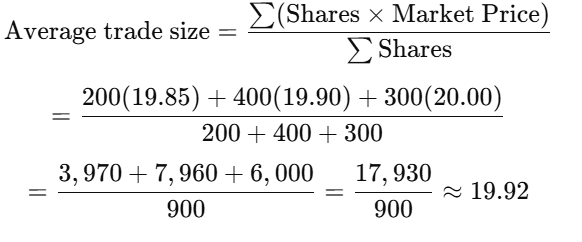
NB: Buyer A’s bid is below the seller’s limit price of Sh. 19.85, so the trade does not execute against this order.
Trading activities from the above transaction:
- The trader has 100 shares remaining after filling the most aggressively priced buy orders.
- Buy orders for the buyer is 1,000 at Sh.19.70. However, this price is below the trader limit price of 19.85, therefore no more trade is possible.
QUESTION 2
April 2025 Question One A
Explain THREE types of equity market structures based on execution mechanisms.
Answer
- Auction Market: A centralized system where all buy and sell orders are brought together and matched at the best available price. A market specialist oversees the process to ensure fairness and efficiency.
- Dealer Market: A decentralized setup where trades occur through dealers who use their own inventory. Investors transact with dealers, who earn profits from the spread between buying and selling prices.
- Hybrid Market: Combines both auction and dealer systems. Trading is largely automated, but market makers step in to provide liquidity and maintain stability, especially during periods of high volatility.
QUESTION 3
December 2024 Question One A&B
- Explain FOUR ways in which transactions are facilitated by financial intermediaries in contributing to a well-functioning financial system in a country.
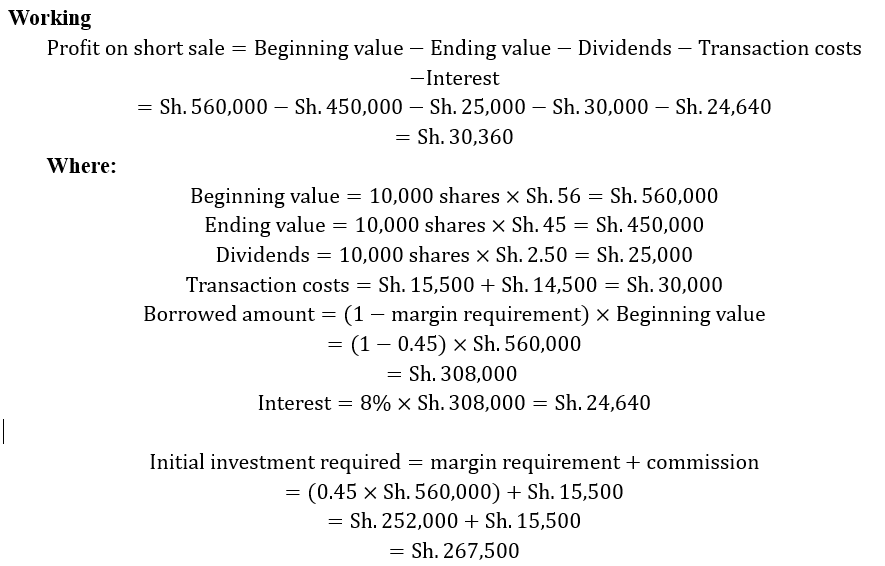
- Simon Mbeo decides to sell short 10,000 shares of Akili Ltd.’s shares when it is selling at its yearly high of Sh.56. The broker has a margin requirement of 45% and the commission on the purchase is Sh.15,500. While holding the position, Akili Ltd. pays a dividend of Sh.2.50 per share. One year later, the investor purchases 10,000 shares at Sh.4 to close out the position and the broker charges a commission of Sh.14,500 and 8% interest on the money borrowed.
Required:
Determine the rate of return on the investment.
Answer
Role of Financial Intermediaries in Kenya:
- Mobilizing Funds:
They gather savings from individuals and businesses and direct them into investments such as loans and infrastructure projects, supporting economic development. - Efficient Payment Systems:
Banks and mobile money platforms enable safe, fast, and cost-effective transactions. - Risk Management:
They offer services like insurance and pooled investments to help individuals manage financial risks. - Expert Guidance:
Professionals such as fund managers and investment bankers provide advisory services and assist firms in raising capital.
Answer

QUESTION 4
August 2024 Question One A&B
- Distinguish between “financial intermediation” and “financial disintermediation” with respect to equity markets.
- Tom Ojionda is considering investment in foreign equity. As an investment analyst, write a clear advisory to Tom pointing out THREE key challenges Tom could encounter.
Answer
Financial Intermediation vs Disintermediation:
- Financial Intermediation: Involves institutions acting as middlemen between investors and borrowers, facilitating transactions and providing expertise.
- Financial Disintermediation: Occurs when investors deal directly with borrowers, often through digital platforms, reducing reliance on traditional intermediaries.
Risks of Foreign Equity Investment:
- Exchange Rate Risk: Returns may be affected by currency fluctuations.
- Political and Economic Risk: Instability or policy changes in foreign countries can impact investments.
- Regulatory Differences: Variations in laws and standards can complicate investment decisions.
QUESTION 5
April 2024 Question Four B
State FOUR factors to consider when making foreign equity investment.
Answer
- Regulatory Restrictions: Some countries limit foreign ownership to protect domestic markets.
- Currency Risk: Returns depend on both asset performance and exchange rate movements.
- Political and Economic Conditions: Changes in policies or economic instability can affect returns.
- Market Liquidity: Some markets may have fewer participants, leading to price volatility and difficulty in trading.
QUESTION 6
April 2024 Question Five D
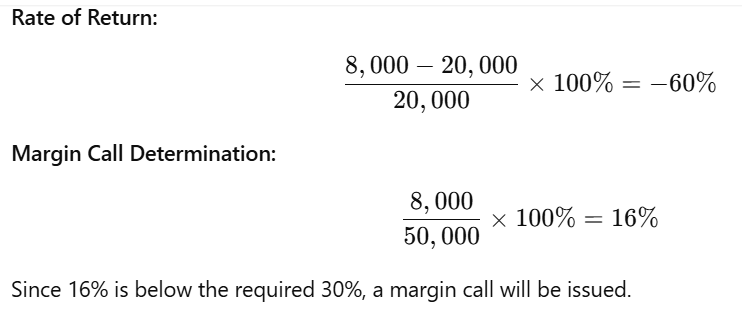
James Onyango opens a brokerage account to sell short 1,000 shares of Popote Ltd. at Sh.40 per share. The initial margin and maintenance margin requirements are 50% and 30% respectively. The margin account pays no interest. A year later, the price of Popote Ltd. has risen from Sh.40 to Sh.50 and the security has paid a dividend of Sh.2 per share.
Required:
Calculate the following:
- The remaining margin in the account.
- The rate of return on the investment.
- Determine whether or not James Onyango will receive a margin call.
Answer
The remaining margin in the account.
Initial margin= 50% × 1,000 × 40 = 20,000
QUESTION 7
December 2023 Question Three C
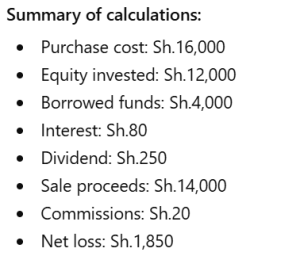
William Wanjohi purchased 500 shares of ABC Ltd. at Sh.32 per share. The shares were purchased at 75% margin. One month later, Wanjohi had pay interest on the amount borrowed at a rate of 2% per month. At that time, Wanjohi received a dividend of Sh. 0.50 per share from ABC Ltd. Immediately after that he sold the shares at Sh,28 per share. He paid a commission of Sh.10 on the purchase and Sh.10 on the sales of the shares.
Required;
Calculate the investor’s rate of the return for the investment for the one month period.
Answer

QUESTION 8
August 2023 Question One A&B
- Highlight THREE reasons why the equity market is important to the economy as a component of the financial system.
- Outline THREE reasons why preference shares are considered less risky than ordinary shares as a type of equity security.
Answer
Importance of Equity Markets:
- Capital Raising: Enables companies to obtain funds for growth.
- Liquidity Provision: Allows investors to easily trade shares.
- Efficient Allocation: Directs capital to productive businesses.
Why Preference Shares Are Safer:
- Priority Dividends: Paid before ordinary shareholders.
- Higher Claim on Assets: In case of liquidation.
- Stable Prices: Less volatility due to fixed returns.
Click either of the links below to get full book
